Eligible for a Small Business Restructure Doesn't Mean It's the Right Path: A Cautionary Tale
The Small Business Restructuring Landscape Has Shifted, Substantially.
What began as a streamlined process to help small businesses navigate post-pandemic financial distress has evolved into something far more nuanced.
The Small Business Restructuring (SBR) regime remains an effective tool for preserving viable businesses. However, in 2026, the conversation has moved beyond simply determining what dividend creditors might receive. Increasingly, successful restructuring outcomes depend on whether creditors, particularly the Australian Taxation Office (ATO), have confidence in the company’s governance, compliance history and future viability.
In many cases, the question is no longer whether a company is eligible for SBR. The more important question is whether an SBR is genuinely suitable.
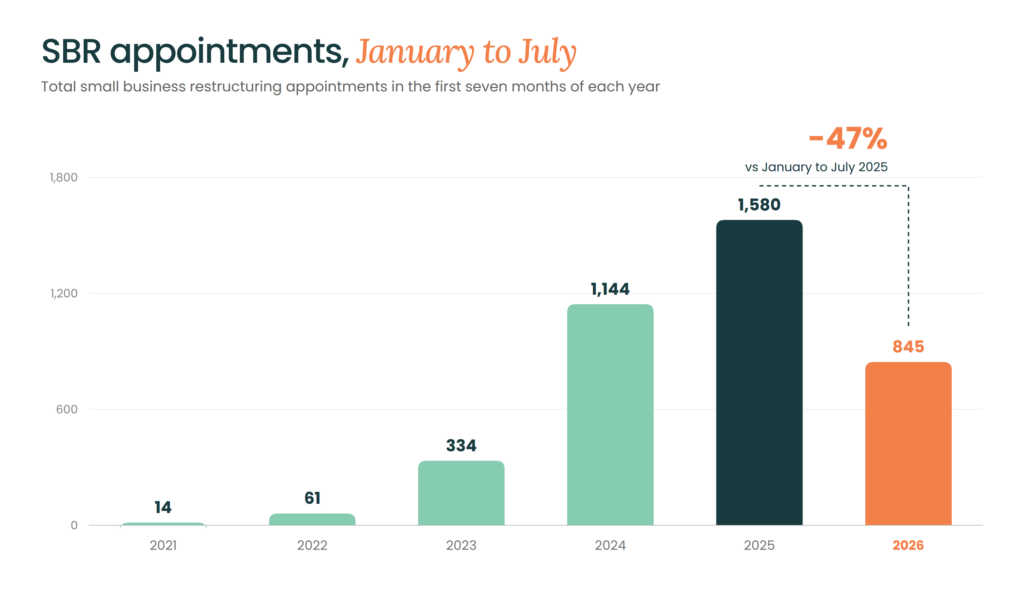
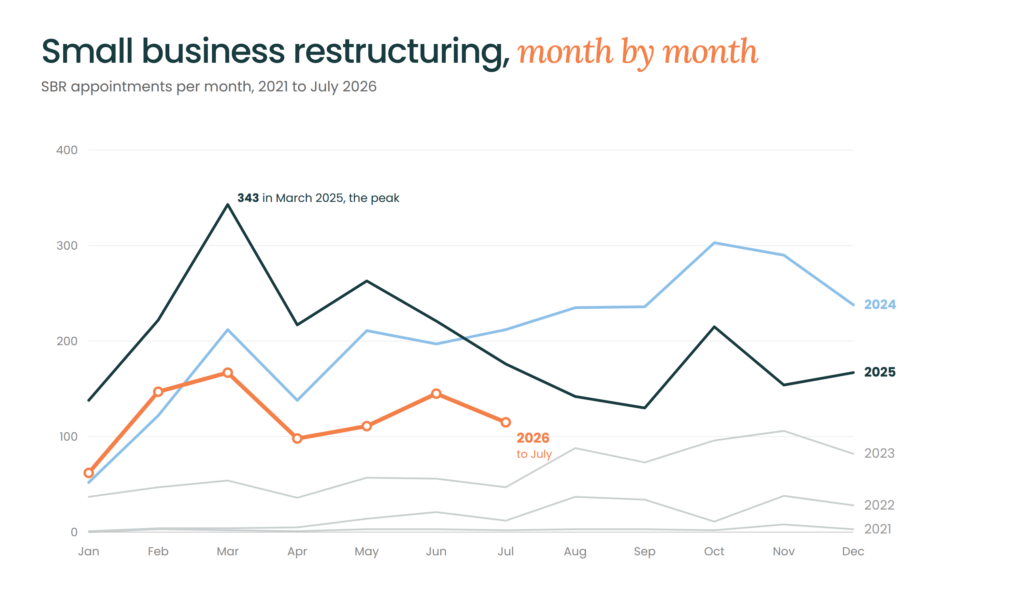
SBR Statistics
The growth in SBR appointments highlights just how important the regime has become as a restructuring tool for small businesses. However, as the number of restructures has increased, so too has the sophistication of creditor scrutiny. Entering the process has become relatively well understood; securing creditor support is where the real challenge now lies. Increasingly, successful restructures are those supported by strong compliance histories, credible forecasts and directors who are able to demonstrate that the causes of financial distress have been identified and addressed. In other words, eligibility may open the door, but suitability is what ultimately determines the outcome.
Eligible for a Small Business Restructure vs Suitable for One
One of the most common misconceptions we encounter is the assumption that eligibility automatically means suitability. Meeting the legislative requirements to propose an SBR plan is simply the starting point. Whether that plan ultimately succeeds depends on a range of practical considerations that sit well beyond the eligibility criteria.
We recently met with a director to discuss the options available to her company. At first glance, the company met the requirements to enter the SBR process under the Corporations Act 2001 (Cth). However, after reviewing its circumstances, we advised that pursuing an SBR was unlikely to deliver the outcome the director was hoping for.
Three issues stood out.
1. A History of Taxation Compliance Problems
The company had a history of late lodgements and had previously defaulted on an ATO payment arrangement.
While these issues did not automatically prevent the company from entering an SBR, they were significant factors that would likely influence how the ATO assessed any restructuring proposal. A compliance history can provide creditors with valuable insight into how a business has managed its obligations prior to seeking relief.
2. Related-Party Debit Loan Accounts
The company also had related-party debit loan accounts that required careful consideration. These balances often attract scrutiny because they raise questions about whether company funds have been drawn out of the business while external creditors remain unpaid. Addressing those balances appropriately is important, but doing so is not always straightforward.
Two solutions are frequently suggested to directors in these circumstances.
- The first is declaring a dividend to offset the loan account. While this may appear to eliminate the debt, transactions of this nature can attract scrutiny if the company is already experiencing financial difficulty. In certain circumstances, a future liquidator may challenge the transaction, creating ongoing risk for directors.
- The second is retrospectively reclassifying the drawings as salary and wages. However, this approach can create additional obligations relating to PAYG withholding and superannuation guarantee requirements, while potentially creating personal tax consequences for the director involved.
Neither approach necessarily resolves the underlying issue. More importantly, neither changes the broader circumstances that creditors will assess when considering whether a restructuring proposal deserves support.
3. Questions Around Ongoing Viability
Perhaps most significantly, there were genuine questions about the company’s ongoing viability. SBR is designed to assist businesses that have a realistic path forward. It can be an excellent tool where financial distress is temporary or capable of being resolved through restructuring.
Where the underlying business model is struggling, however, a restructuring proposal becomes far more difficult to support. Creditors are ultimately being asked to compromise their debts on the basis that the business has a future. If that proposition is uncertain, obtaining support becomes considerably more challenging.
The Search for a Better Answer
The director was understandably disappointed by the advice. Like many directors facing financial stress, she wanted to believe there was a simpler solution available.
Rather than accepting the challenges identified, she continued seeking alternative views and exploring different opinions. Eventually, she received advice that was more closely aligned with the outcome she was hoping for: that an SBR would provide a practical and achievable pathway forward.
The difficulty was that the company’s circumstances had not changed.
The compliance history was the same. The related-party loan accounts remained unresolved. Questions around viability still existed.
What changed was not the underlying position of the company. What changed was the advice that the director chose to place greater weight on.
This is a scenario that advisers encounter regularly. When people are under significant personal, financial or professional pressure, there is a natural tendency to favour information that confirms what they want to believe. Challenging advice can feel pessimistic, while reassuring advice can feel constructive. Yet restructuring outcomes are determined by objective circumstances, not by the attractiveness of the narrative surrounding them.
Insolvency and restructuring processes have a way of exposing reality. Issues that are overlooked, discounted or rationalised during the decision-making process frequently re-emerge later when creditors, regulators or practitioners conduct their own assessments.
The lesson is not that directors should avoid seeking second opinions. On the contrary, obtaining additional advice is often sensible. The risk arises when the purpose of seeking another opinion shifts from testing a conclusion to finding someone who will deliver a preferred answer.
The Role of Trusted Advisers
This is where accountants play a particularly valuable role. For many directors, their accountant is the first person they call when financial pressure begins to build. More often than not, they are also the adviser whose judgment carries the greatest weight.
One of the most important services an adviser can provide is helping clients distinguish between what is technically possible and what is realistically achievable. That sometimes involves difficult conversations. It may mean challenging assumptions, questioning optimistic forecasts, or explaining why a particular strategy is unlikely to succeed despite meeting the basic eligibility criteria. Those conversations are rarely easy, but they are often the conversations that matter most.
A successful restructuring process begins with an honest assessment of the company’s circumstances. Directors who understand the reality of their position are far better equipped to make informed decisions than those who focus solely on finding the answer they hoped to hear.
We are always pleased to be a sounding board for accountants and their clients, whether or not the conclusion is the one the client was hoping for.
This article provides general information only and does not constitute legal, financial or taxation advice. It should not be relied upon as a substitute for advice specific to your circumstances. References to the Corporations Act 2001 (Cth) should be independently verified before republication.
About the author
Greg Quin is a Managing Partner at Equinox (formerly HLB Mann Judd Insolvency WA). He specialises in guiding directors, accountants and lawyers through complex insolvency and restructuring matters, from early-stage financial distress through to formal appointments, with a focus on practical outcomes over textbook process.
Greg works closely with referral partners to identify the right course of action early, whether that’s Safe Harbour, voluntary administration, or a negotiated resolution with the ATO or other creditors. He’s known for straightforward, commercially-minded advice and for managing appointments with the confidentiality and professionalism clients expect when the stakes are high.

For advice on an insolvency matter, contact Greg on 08 9215 7900 or 0402 943 091, or via email at greg@equinoxri.com.au.