Insolvency by the Numbers: July to September 2026
ASIC’s latest insolvency statistics have been released and, at first glance, there has been another fairly significant increase in corporate insolvencies.
There is, however, an important qualification to the headline number.
This is the first in a quarterly series where we’ll look at the ASIC statistics, particularly from a WA perspective, and consider what they might mean for accountants and their clients.
The headline number needs some context
According to ASIC’s preliminary figures, 4,074 companies entered external administration or had a controller appointed for the first time between 1 July and 27 September 2026.
That compares with 3,451 over the corresponding period in 2025, an apparent increase of 18%.
The difficulty with that comparison is that the August 2026 figures include 542 related companies in the Bathla Group, a property development and construction group whose collapse has been widely reported.
ASIC’s statistics count individual companies rather than corporate groups, so a large group appointment can have a significant impact on the numbers.
If the Bathla companies are removed, the national figure is approximately 3,530, only around 2% higher than the same period last year.
So my reading of the national numbers is that corporate insolvencies remain at a high level, but there hasn’t necessarily been another material step-up this quarter.
That is still significant. FY2025–26 finished with 14,153 companies entering external administration, slightly below the 14,722 recorded in FY2024–25 but still well above earlier years in ASIC’s current series.
The appointment mix is perhaps more interesting
Looking at the individual appointment types nationally between 1 July and 27 September:
- Creditors’ voluntary liquidations: 1,644, up from 1,465 (+12%).
- Court liquidations: 716, down from 833 (−14%).
- Small business restructurings: 308, down from 437 (−30%).
- Voluntary administrations: 1,022, up from 335, although almost all of the Bathla Group appointments were VAs. Excluding those appointments, VAs are still up by around 40%.
I wouldn’t read too much into one quarter, but the increase in CVLs alongside a fall in court liquidations is interesting.
One possible explanation is that more directors are dealing with financial distress themselves rather than waiting for a creditor to commence winding-up proceedings. That would be a positive development if it means advice is being sought earlier. Equally, there can be timing differences in court applications, so I would want to see the trend continue over another few quarters before drawing any firm conclusions.
The WA numbers
Western Australia is a little more interesting because the movement here isn’t distorted by the Bathla appointments, which were almost entirely in NSW.
235 WA companies entered external administration during the period, compared with 207 a year earlier, an increase of 14%.
It is also the fifth consecutive year in which the September-quarter figure has increased.
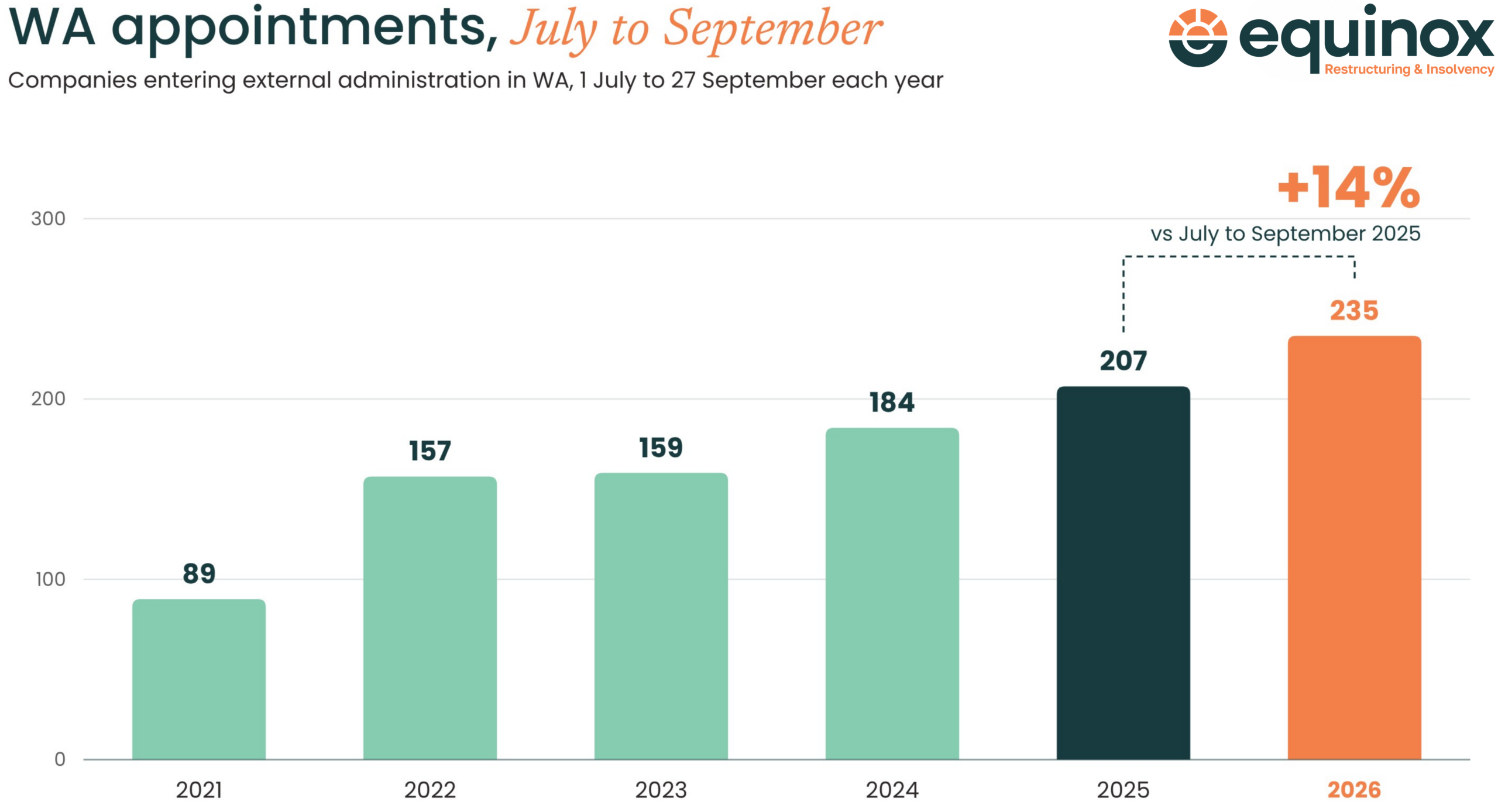
The comparison with 2021 needs to be treated cautiously because insolvency activity at that time was still being affected by COVID-era support measures.
The more recent figures are probably more useful. They show a fairly consistent increase over the past three years rather than a sudden spike.
Within the WA figures:
- Construction recorded 58 appointments, up from 36.
- Voluntary administrations increased from 32 to 57.
- Court liquidations fell from 43 to 24.
- Mining increased from 16 to 26.
- Hospitality increased from 29 to 32.
WA is still a relatively small market, so a significant corporate group failure can move the figures quite quickly. For that reason, I’d prefer to look at the direction over several quarters rather than place too much emphasis on any single three-month period.
From what we’re seeing in practice, there isn’t one particular issue driving every appointment. What is common, though, is that businesses which have been carrying cash flow or tax problems for some time are finding it increasingly difficult to keep doing so. Once those problems have accumulated, the range of available options can narrow surprisingly quickly.
What does this mean for your clients?
Statistics are useful for understanding what’s happening across the market, but the more useful exercise for an accountant is identifying which clients are beginning to show the same warning signs.
There are four areas I would be looking at.
1. Clients falling behind with lodgements
As we discussed in August, the ATO has become more active in moving matters from reminder letters through to recovery action, including DPNs and garnishees.
Repeatedly overdue lodgements are often one of the first signs that a client is struggling.
2. Construction clients
Construction continues to account for a significant proportion of appointments, both nationally and in WA.
That doesn’t mean every construction business is in difficulty, but where margins have tightened or tax and supplier debt is accumulating, it is worth looking more closely.
3. Clients repeatedly borrowing to meet operating costs
There is an important difference between funding a temporary working-capital requirement and borrowing simply to meet continuing trading losses.
If every short-term facility is followed by another one, it may be time to look at the underlying business rather than the next source of funding.
4. Businesses heading into Christmas with very little cash headroom
The Christmas and January period catches businesses out every year.
Trading may slow or stop for several weeks, while wages, rent, BAS and superannuation obligations don’t necessarily do the same. If a client’s cash position already looks tight, it is worth modelling that period now rather than discovering the problem in mid-January.
The increase in WA insolvencies isn’t a reason to assume that every struggling client is heading towards an insolvency appointment.
It is, however, a good reason to have the conversation a little earlier. In our experience, the earlier a financial problem is properly identified, the more options there generally are to deal with it.
This article provides general information only and does not constitute legal, financial or taxation advice. It should not be relied upon as a substitute for advice specific to your circumstances. References to the Corporations Act 2001 (Cth) should be independently verified before republication.