Legal Phoenix, or Illegal Phoenixing? The Line Your Client Might Not See
When a company can’t pay its debts, some directors sell the business and its assets into a new company, then place the old company into liquidation. Done properly, that’s a lawful “legal phoenix,” a legitimate and fairly common restructuring tool. Done poorly, it’s illegal phoenixing, and it can expose the director, the purchaser, and their advisers to personal liability.
As the first point of contact for many directors, accountants and lawyers are often the ones best placed to spot the difference, ideally before a transaction is signed, not after a liquidator starts asking questions.
It’s not the restart that’s illegal
Businesses fail and restart for entirely legitimate reasons, and Australia’s insolvency framework is built to allow that. What separates a legal phoenix from illegal phoenixing isn’t the fact that a new company continues the trade. It’s whether the old company’s creditors were treated fairly along the way: whether assets were sold for proper value, whether the sale proceeds were actually available to the liquidator, and whether the whole transaction was transparent rather than designed to leave creditors with nothing.
ASIC and the ATO run a joint Phoenix Taskforce specifically targeting arrangements where a company is deliberately liquidated to avoid paying creditors, employees and tax, with a successor company continuing the same business in its place.
The legal test: a “creditor-defeating disposition”
The line between the two isn’t a feeling, it’s a defined legal concept. A transaction crosses into illegal phoenixing when it meets the test for a creditor-defeating disposition (CDD): broadly, a disposition of company property for less than its market value, or less than the best price reasonably obtainable, made with the effect of preventing, hindering or significantly delaying creditors’ access to that property in a liquidation.
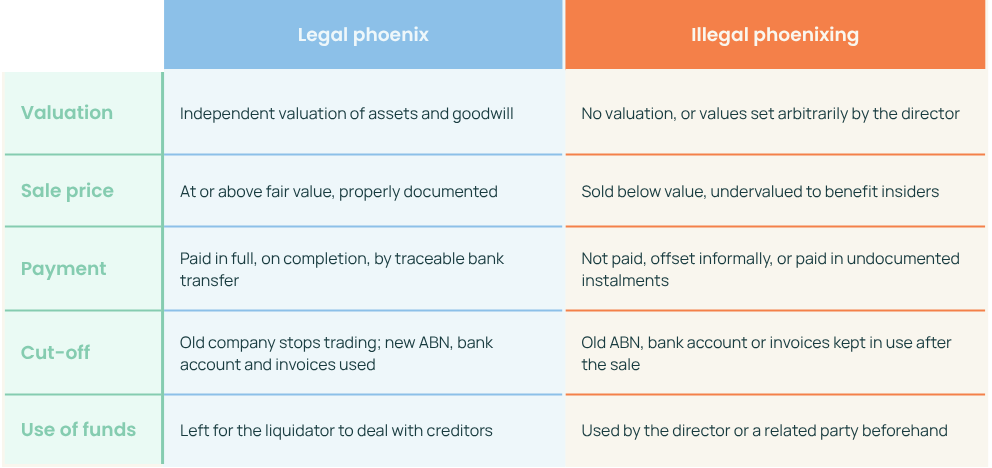
A CDD doesn’t require proof the director set out to defraud anyone. If the effect of the disposition is to leave creditors worse off than they should have been, that’s enough to engage the regime. Since the 2020 illegal phoenixing reforms, a CDD carries civil and, in serious cases, criminal consequences for the director, and can extend to anyone who procured, incited, induced or assisted the disposition, which is why advisers who help structure a sale need to satisfy themselves the four checkpoints below are genuinely met, not just documented as if they were.
Director ID: closing the “serial phoenix” loophole
One of the practical obstacles regulators used to face was simple: a director could dissolve one company and resurface as a director of the next under a slightly different name or identity, making repeat phoenix activity hard to trace. The Director Identification Number (DIN) regime closes that gap. Every eligible director must now hold a unique, verified DIN that stays with them for life, regardless of how many companies they’re a director of or how many times they resign and re-appoint.
For advisers, this matters in two ways. First, it means a director’s history is now far more traceable across entities, so a pattern of repeated failed companies is easier for ASIC, the ATO and liquidators to connect than it once was. Second, failing to apply for a DIN when required, or providing false identity information to obtain one, is itself a separate offence, independent of anything that happens with the company later.
Four checkpoints
Red flags worth a second look
- The sale happens only after a DPN, statutory demand or wind-up begins
- No independent valuation, or values are set by the director alone
- The purchaser has no funds of its own to pay for the business
- Customers keep paying the old company, or the old ABN stays in use
- Sale proceeds are spent, distributed or repaid to related parties before a liquidator is appointed
Why it matters even if the sale “feels” fine
If a sale is later found to be a CDD, a liquidator can apply to unwind it, claw back the property (or its value) from the purchaser, and pursue recovery action against the director and anyone who assisted. Directors, purchasers and the professionals who guided them can all be drawn into the fallout. And the exposure isn’t limited to the transaction itself: unpaid PAYG withholding, SGC and GST left behind in the old company can still trigger a Director Penalty Notice against the individuals who ran it, regardless of what happens to the new entity, and now more easily traced back to them through their DIN.
The four pillars above, fair value, a proper price, traceable payment, and correct use of funds, are far easier to get right before a sale than to defend after one.
If a client raises this with you
Encourage them to get independent advice on the sale before it happens, not after. Fair value, proper documentation, traceable payment and a clean break between the two companies are far easier to get right in advance than to defend later, once assets have moved and the old company is in a liquidator’s hands, the options for everyone involved narrow quickly.
We’re often the first call a referrer makes when something about a proposed sale doesn’t sit right, well before any formal appointment is on the table. A confidential conversation early gives your client more options than the same conversation held after the event.
If you’d like to talk through a specific situation, Greg Quin and Trudie Walsh are always happy to be a sounding board.
This article is general information only and does not constitute legal, tax or financial advice. Each situation is unique and requires individual professional assessment.
About the author
Greg Quin is a Managing Partner at Equinox (formerly HLB Mann Judd Insolvency WA). He specialises in guiding directors, accountants and lawyers through complex insolvency and restructuring matters, from early-stage financial distress through to formal appointments, with a focus on practical outcomes over textbook process.
Greg works closely with referral partners to identify the right course of action early, whether that’s Safe Harbour, voluntary administration, or a negotiated resolution with the ATO or other creditors. He’s known for straightforward, commercially-minded advice and for managing appointments with the confidentiality and professionalism clients expect when the stakes are high.

For advice on an insolvency matter, contact Greg on 08 9215 7900 or 0402 943 091, or via email at greg@equinoxri.com.au.