When "Just Get Through the Month" Becomes the Business Model
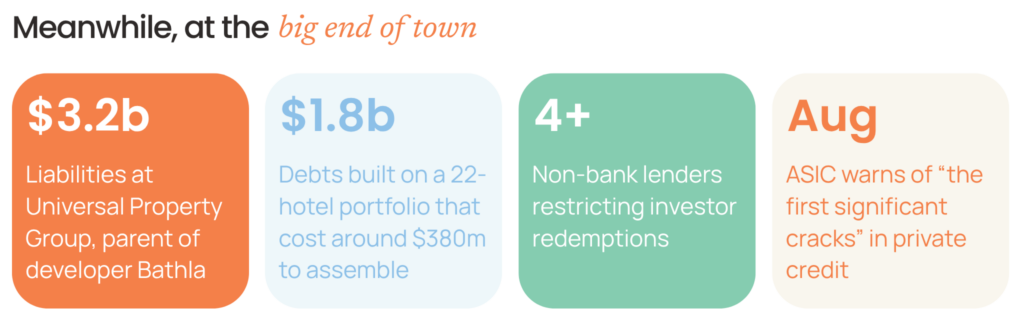
Private credit has been in the headlines recently, and for good reason. Last month in August, ASIC has warned of “the first significant cracks” in the sector, pointing to the collapse of major borrowers and redemption freezes at several large funds. The Reserve Bank has voiced its own concern about a market where, in Governor Michele Bullock’s words, “people don’t know where the leverage is.”
The examples making headlines are large ones. NSW property developer Bathla appointed administrators in August, with parent company Universal Property Group carrying $3.2 billion in liabilities, the majority reportedly owed to private credit funds. Jon Adgemis, the former KPMG partner behind Public Hospitality Group’s 22-hotel portfolio, now ranks equal first with Alan Bond as Australia’s largest ever personal bankrupt, with debts of $1.8 billion built on a portfolio that cost around $380 million to assemble, much of it funded through private credit syndicates. Separately, non-bank lenders including Merricks, Longreach Credit, Centuria Bass and MA Financial have all moved to restrict investor redemptions, citing liquidity pressure.
Most of that commentary is aimed at the big end of town: property developers with billion-dollar exposures, listed fund managers, superannuation flows. But the same underlying dynamic, borrowing to bridge a gap rather than solve a problem, is playing out constantly at the other end of the market, in businesses turning over a few million dollars a year rather than a few billion.
We’re seeing it regularly at the moment, and it’s worth naming as a pattern rather than a one-off.
The pattern
A growing number of small and mid-sized businesses are relying on short-term cash flow facilities, the kind offered by providers where the barrier to obtaining credit is relatively low, to cover recurring obligations: a BAS payment, a wages run, rent, a supplier invoice. Each facility taken in isolation looks manageable, and often genuinely is, when it bridges a short, specific timing gap.
The pattern that concerns us is different. It’s businesses using these facilities not to bridge a gap, but to fund ongoing trading losses, month after month, while waiting for something external to change the position: a large debtor to pay, a new contract to start, a quieter season to end. Each new facility becomes less a bridge and more a patch, often taken out partly to service the last one. The business keeps trading, invoices keep going out, wages keep getting paid, and from the outside everything looks like it’s continuing as normal. Underneath, the actual operating losses are being masked by an increasingly expensive layer of borrowed cash rather than being addressed.
This is a meaningfully different problem to a genuine timing gap, and it’s much harder to spot from the outside, which is exactly why it tends to run longer than it should.
Why it escalates faster than directors expect
A few features of this kind of lending make the position deteriorate faster than a traditional overdraft or term loan would:
- Repayment terms are short and fixed, often daily or weekly, regardless of what the business actually collects that week.
- Multiple facilities stack across multiple lenders, and new ones are frequently taken out partly to service existing ones, which converts what looks like several separate cash flow events into one structural debt problem.
- Effective cost of funds is high relative to bank finance, so a business funding genuine losses this way sees the gap widen, not close, the longer it continues.
- No single lender sees the whole picture. Each facility provider only sees its own exposure. Often nobody, including the director, has totalled up the combined weekly repayment burden across all of them.
- The trading loss itself stays hidden in plain sight. Revenue keeps flowing, bills keep getting paid, and the business can look busy and functional right up until the borrowing can no longer keep pace.
None of this is exotic. It’s the SME equivalent of the pattern regulators are now scrutinising in the private credit majors: debt taken on to manage today’s position, without a clear line of sight to how or when it actually gets repaid rather than continually refinanced.
What accountants and advisers are well placed to see first
Directors in this position rarely describe it as a loss-making business. They describe it as a timing problem: “once this invoice is paid” or “once the new contract kicks in.” That framing is sometimes genuine. Often, though, it’s masking a business whose underlying trading position has been loss-making for some time, with short-term borrowing filling the gap rather than any real prospect of the loss reversing.
A few practical signs worth watching for across a client base, not just in an individual matter:
- Multiple short-term lender facilities appearing in bank statements, particularly several drawn within a 6 to 12 month window
- Daily or weekly direct debits to non-bank lenders sitting alongside normal trading activity
- New short-term borrowing appearing shortly after an existing facility is drawn down or renewed
- Underlying trading losses that persist across several reporting periods, even as short-term borrowing keeps the business liquid
- ATO debt building in parallel, since BAS and superannuation obligations are often the first casualties when cash is tight
- Directors who are confident the position will resolve itself but can’t point to a specific, dated event that changes the underlying trading result, not just the cash position
None of these signs alone means a business is insolvent or heading that way. But where several appear together across a client, and particularly where they recur across multiple clients in similar industries, it’s a pattern worth raising directly and early, rather than waiting for a lender to force the issue.
Why early engagement matters more here, not less
The instinct with this kind of lending is to keep going until the external event arrives and resets the position, because each individual facility feels solvable on its own terms. The risk is that by the time it’s clear the underlying business isn’t going to trade its way out, the options have narrowed considerably: less unencumbered cash flow, less trading history left to work with, and a debt stack that’s grown more expensive with every renewal.
The earlier this pattern is identified, whether by the director, their accountant, or in a routine review of the numbers, the more genuine options remain: restructuring the debt, addressing the underlying loss directly, or, where appropriate, a formal restructuring process while the business still has something to restructure.
If you are seeing this pattern across your client base, an early, informal conversation is almost always more useful than waiting for a lender to force the issue. We’re happy to talk through what you’re seeing, confidentially and without obligation, to help you and your clients work out what the real options are before they narrow.
This article is general information only and does not constitute legal, financial or insolvency advice. It should not be relied upon as a substitute for advice specific to your circumstances or those of your client.
About the author
Greg Quin is a Managing Partner at Equinox (formerly HLB Mann Judd Insolvency WA). He specialises in guiding directors, accountants and lawyers through complex insolvency and restructuring matters, from early-stage financial distress through to formal appointments, with a focus on practical outcomes over textbook process.
Greg works closely with referral partners to identify the right course of action early, whether that’s Safe Harbour, voluntary administration, or a negotiated resolution with the ATO or other creditors. He’s known for straightforward, commercially-minded advice and for managing appointments with the confidentiality and professionalism clients expect when the stakes are high.

For advice on an insolvency matter, contact Greg on 08 9215 7900 or 0402 943 091, or via email at greg@equinoxri.com.au.