Voluntary Administration: What It Is, What It Isn't, and Why More Companies Are Using It
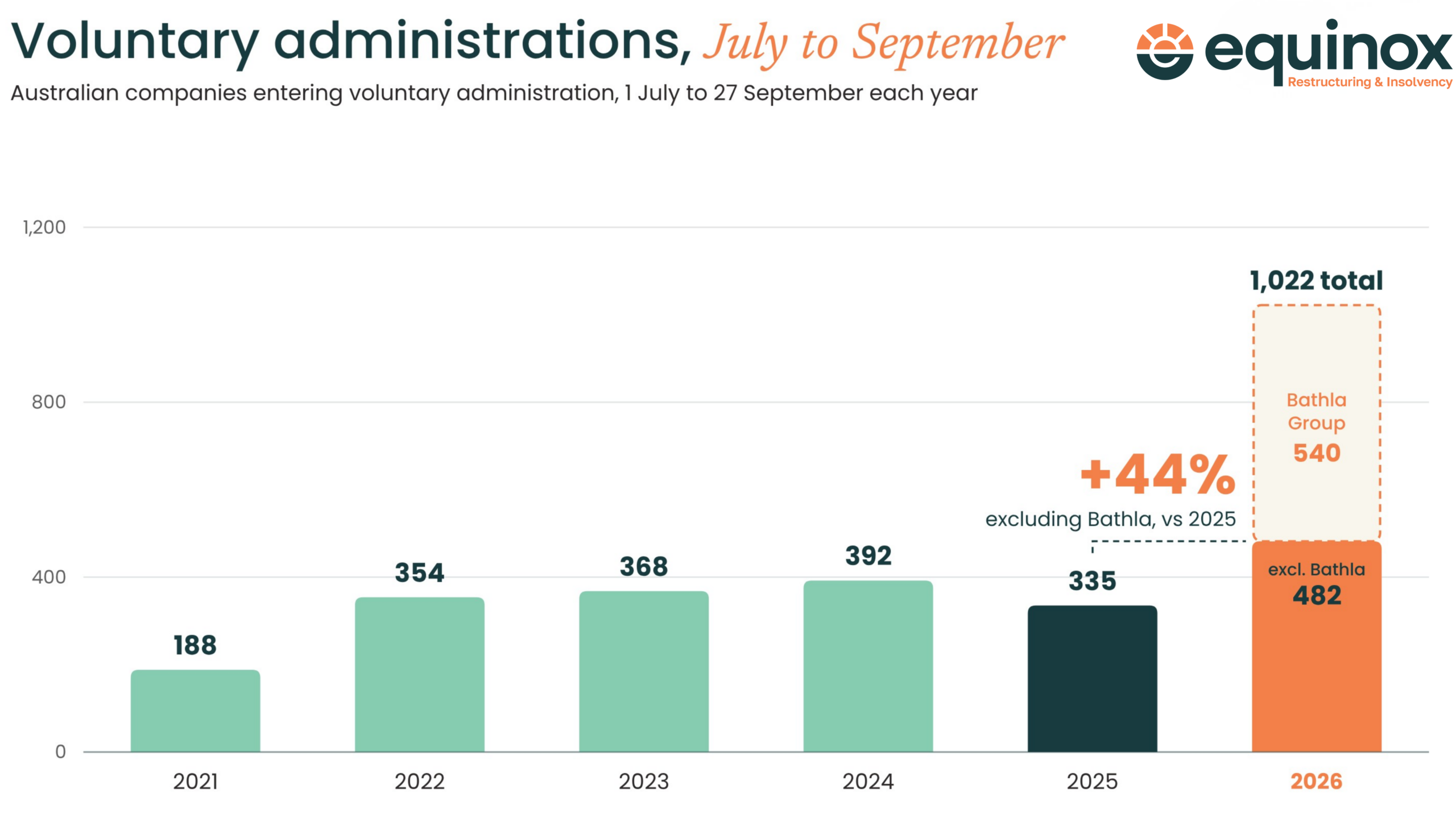
Voluntary administration received some unusual attention in August when more than 540 companies entered VA on a single day.
According to ASIC, 542 of the appointments related to companies in the Bathla Group, a property development and construction group whose difficulties have been widely reported.
That’s obviously an exceptional situation, and I don’t propose to comment on the Bathla matter itself. What it does provide is a useful opportunity to explain voluntary administration, because there is still quite a bit of misunderstanding about what the process is intended to achieve.
Even excluding the Bathla companies, around 480 companies entered VA nationally between 1 July and 27 September 2026, compared with 335 over the same period last year. In WA, appointments increased from 32 to 57.
So, what actually happens when a company enters voluntary administration, and when might it be appropriate?
What is voluntary administration?
In broad terms, voluntary administration involves an independent registered liquidator being appointed as administrator and taking control of the company while its financial position and options are assessed.
The process is deliberately relatively quick.
The administrator investigates the company’s affairs, considers the options available and reports to creditors. Creditors ultimately decide what happens next.
Where a business has a viable future, that will often involve a proposal for a deed of company arrangement, or DOCA.
A DOCA is essentially a compromise between the company and its creditors. The proposal will differ from case to case. It might involve funding from the directors or another party, continued trading, the sale of assets, or some combination of those things.
The important point is that there needs to be a reason for creditors to support it. Ordinarily, that means demonstrating that the proposed outcome is better for creditors than an immediate liquidation.
How does the process work?
The directors can appoint an administrator where they resolve that the company is insolvent, or is likely to become insolvent, and an administrator should be appointed. The proposed administrator must first provide written consent to act.
Once appointed, the administrator takes control of the company. The directors remain in office, but their powers are suspended during the administration.
A first meeting of creditors is generally held within eight business days. Its main purpose is to allow creditors to decide whether to appoint a committee of inspection and whether they wish to replace the administrator.
The administrator then investigates the company’s financial affairs and the alternatives available to creditors. The directors are also required to provide information regarding the company’s business, property and financial circumstances.
A second meeting is then held at which creditors decide between three alternatives:
- the company enters into a DOCA;
- the company goes into liquidation; or
- the administration ends and control of the company returns to the directors.
The third outcome is relatively uncommon.
The process ordinarily operates within a 20-business-day convening period, or 25 business days where the administration begins in December or close to Easter, although the Court can extend that period.
One of the practical benefits of VA is the breathing space created while this process occurs. Proceedings against the company are generally stayed and, subject to certain exceptions, personal guarantees given by directors can’t be enforced during the administration without leave of the Court.
There are important exceptions. In particular, a secured creditor holding security over all or substantially all of the company’s property may still be able to enforce its security if it acts within the statutory decision period.
Some common misconceptions
There are a few misconceptions about VA that come up fairly regularly.
1. A VA doesn’t necessarily mean the business is finished.
Sometimes liquidation will ultimately be the appropriate outcome. In other cases, the administration provides an opportunity to restructure the company’s affairs or sell the business while it is still operating.
ASIC’s review of voluntary administrations and DOCAs, which we discussed in July, found that almost half of the companies subject to a DOCA continued trading.
2. It’s not a process reserved for large companies.
VA can be used by companies of different sizes.
However, cost and complexity matter. A very small business with relatively straightforward debts may have other options available, including the small business restructuring regime.
3. It doesn’t automatically solve a director’s DPN exposure.
This is an important one.
Appointing an administrator can have consequences for director penalty liabilities in particular circumstances, but it is not a mechanism for simply extinguishing a director penalty notice. In particular, an appointment does not remit lockdown DPN liabilities.
4. It’s different from small business restructuring.
Under the small business restructuring process, directors remain in control of the company while a restructuring practitioner assists with developing a restructuring plan.
In a voluntary administration, control passes to the administrator.
That distinction is important, particularly for business owners considering their options.
Why can one corporate collapse result in hundreds of VAs?
The Bathla appointments also illustrate why insolvency statistics can sometimes be misleading if you only look at the headline number.
Property groups commonly use a separate company for individual projects. There can be financing, security, commercial and risk reasons for doing that.
But each company remains a separate legal entity.
So if a large group with hundreds of project companies encounters financial difficulty, hundreds of individual insolvency appointments can result from what would ordinarily be thought of as one corporate group failure.
It also matters practically for creditors. A subcontractor may think of itself as being owed money by the broader group, but its creditor claim will generally be against the particular company with which it contracted.
When can a VA make sense?
There isn’t a formula for this, but there are a few things I would normally want to see before considering VA as a realistic option.
There should generally be something worth preserving. That might be a profitable core business, valuable contracts, employees, intellectual property or assets that are likely to achieve a better outcome if sold as part of a going concern.
There also needs to be a realistic proposal.
If a DOCA is being contemplated, where will the money come from? It could come from continued trading, the sale of assets, the directors, an investor or another third party. But there needs to be a credible source of funding.
And there needs to be a reason for creditors to vote for it.
If the proposal leaves creditors no better off than liquidation, it becomes much harder to justify.
Conversely, VA may add little where the business has ceased, there are no meaningful assets or prospects of continued trading, and there is no realistic source of funding for a DOCA.
Where accountants can help
For me, one of the most important issues is timing.
By the time a company has exhausted its cash, stopped paying employees or suppliers and accumulated substantial tax debt, there may not be much left to restructure.
The conversation is much more useful when it happens before that point.
If you have a client beginning to experience financial pressure, I’d be asking:
- Is the underlying business profitable, or capable of being profitable, if the existing debt burden is dealt with?
- Is there a director, investor, purchaser or other party who might fund a proposal?
- Are the company’s tax lodgements up to date?
- What happens to cash flow over the next three to six months?
- Has the client considered all of the realistic alternatives, including a turnaround, small business restructuring, voluntary administration or an orderly winding-up?
Not every financially distressed company needs a voluntary administration. Quite often it isn’t the right answer.
But where there is a viable business underneath the financial problem, VA can provide a short period in which the company’s position can be properly assessed and creditors can be given an alternative to immediate liquidation.
As with most restructuring options, it tends to be more useful when the conversation starts early.
This article provides general information only and does not constitute legal, financial or taxation advice. It should not be relied upon as a substitute for advice specific to your circumstances. References to the Corporations Act 2001 (Cth) should be independently verified before republication.