"Can I Just Resign?" What Accountants Should Check When a Director Wants Out
When a company starts to struggle, there’s a question that comes up, usually from the director who is least involved in the day-to-day operations: “Can I just resign?”
It’s an understandable instinct however, resignation is rarely the clean exit a director hopes for. It doesn’t erase what has already happened, and done carelessly it can create new problems.
Here is how we walk directors and their accountants through it.
Check 1: Understand what resignation does and doesn’t do
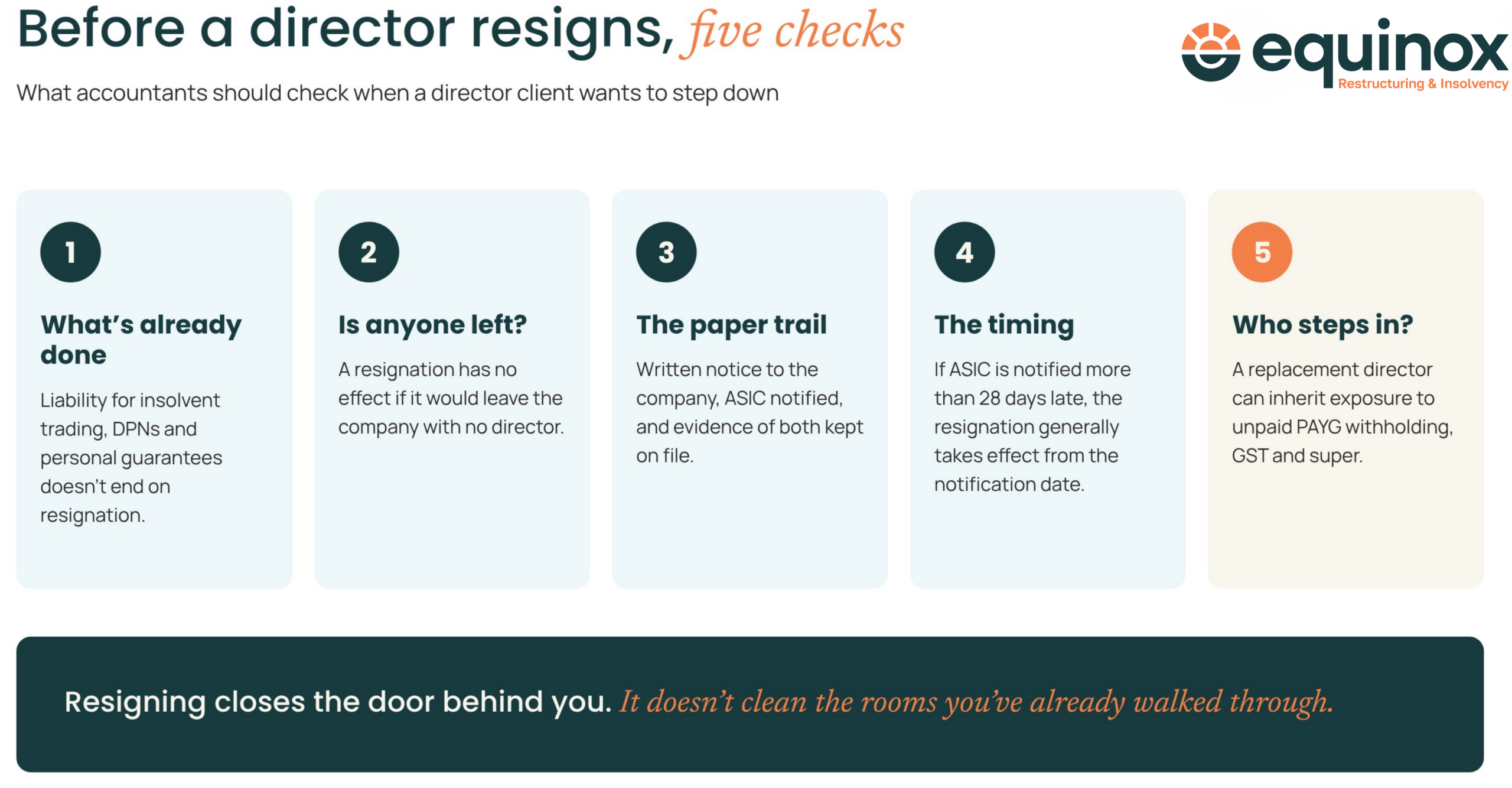
Resignation ends a director’s role from the date it takes effect. It does not end liability for what happened while they were a director, including:
- Insolvent trading: a director can be personally liable for debts the company incurred while they were a director, if there were reasonable grounds to suspect insolvency at the time (s588G). Resigning later doesn’t change that.
- Director Penalty Notices (DPNs): resigning doesn’t help with DPNs issued by the ATO. A director stays liable for PAYG withholding, GST and super amounts that fell due while they were in office.
- Personal guarantees: a personal guarantee is a separate contract between the director and the creditor (a bank, landlord or supplier, for example). It isn’t tied to the role of a director, so resigning doesn’t end it. You stay liable under its terms until the creditor releases you or the guarantee ends according to its own terms.
Check 2: Is resignation even possible
The Corporations Act now says a director’s resignation has no effect if the company would be left with no directors (s203AB). For the sole director of a company that’s still trading, resignation simply isn’t available as an exit.
This rule came in as part of the illegal phoenixing reforms. It stops a company being left as an empty shell with no one accountable for it. In practice, a sole director wanting out has two real choices: find a replacement director willing to take on the role with full knowledge of the company’s position, or deal with the company’s affairs properly.
Check 3: The paper trail
If resignation is possible, it should be documented properly:
- Give written notice to the company at its registered office (s. 203A). This is a replaceable rule, so check the company’s constitution too.
- Make sure ASIC is notified. The company must notify ASIC within 28 days (s. 205B(5)). The director can also notify ASIC directly, with a copy of the resignation letter (s. 205A).
- Keep evidence: a copy of the notice, proof of delivery and the ASIC confirmation.
Check 4: Watch the timing
The Act now limits backdating. Under s. 203AA, if ASIC isn’t notified within 28 days after the director stopped being a director, the resignation takes effect from the day notice is lodged with ASIC instead. The director or company can apply to ASIC (within 56 days) or the Court (within 12 months) to fix the earlier date, but that isn’t automatic.
A resignation lodged months after a director “left” won’t protect them for the months (or longer) in between. If a client tells you they “resigned ages ago”, a quick check the ASIC record is worth doing.
Check 5: Consider what a replacement director is walking into
Where a resignation depends on someone else stepping in, that person deserves the full picture. A new director can inherit DPN exposure for existing unpaid amounts if they don’t act within a short 30-day period after their appointment.
Installing a relative or a nominee to make a resignation “work” is a red flag. It shifts risk onto someone who may not understand it, and it can draw attention from ASIC and the ATO rather than deflect it.
Ask a better question
A director who wants out is often telling you something important about the business. That moment is worth taking seriously, because it’s usually the right time to have the conversation about where the company is heading and what exposures already exist, while there are still options on the table.
This article provides general information only and does not constitute legal, financial or taxation advice. It should not be relied upon as a substitute for advice specific to your circumstances. References to the Corporations Act 2001 (Cth) should be independently verified before republication.