ATO Debt Continues to Climb as the Commissioner Steps Up Recovery Activity
The ATO’s 2025-26 Annual Report provides further evidence of a significant shift in the tax debt environment. While payment performance has improved, the stock of outstanding debt continues to grow and the ATO is making increasingly active use of its recovery powers.
The headline numbers are substantial. Total reported ATO debt holdings reached $126.27 billion at 30 June 2026, up from $101.56 billion a year earlier. Within that figure, collectable debt increased from $54.25 billion to $62.17 billion, an increase of approximately $7.9 billion. Debt subject to objection or appeal was $26.78 billion and insolvency debt reached $20.67 billion.
There is an important qualification to the total debt comparison. From 2025-26 the ATO changed the way it reports debt regarded as uneconomical to pursue. On the new basis, the comparable 2024-25 total would have been approximately $115 billion, rather than the previously reported $101.56 billion. Even allowing for that reporting change, however, the direction is clear: the tax debt book remains large and is continuing to grow.
Small business remains at the centre of the debt issue
The figures are particularly relevant for advisers to SMEs.
Small business accounted for $40.74 billion of collectable debt at 30 June 2026, up from $35.86 billion in 2024-25. Once debt subject to objection or appeal, insolvency debt and non-pursued debt are included, total small business debt holdings were $68.26 billion.
The ATO itself says small businesses account for approximately two-thirds of total collectable debt. It identifies several contributors to the continuing debt balance, including new unpaid liabilities arising through lodgements and compliance activity, interest accruing on older debts, and previously inactive debt being returned to active recovery following work to improve account accuracy.
For advisers, this is significant. A tax debt should no longer be viewed simply as another creditor balance capable of remaining on the balance sheet indefinitely. The ATO’s approach increasingly distinguishes between taxpayers experiencing genuine short-term difficulty who engage with it, and taxpayers whose liabilities remain overdue and unmanaged.
Better payment performance, but firmer recovery
There is a somewhat counterintuitive feature of the annual report. Current payment performance is actually improving.
In 2025-26, 90.1% of tax liabilities were paid on time and in full, compared with 89.4% in the previous year. 95.3% were paid within 90 days.
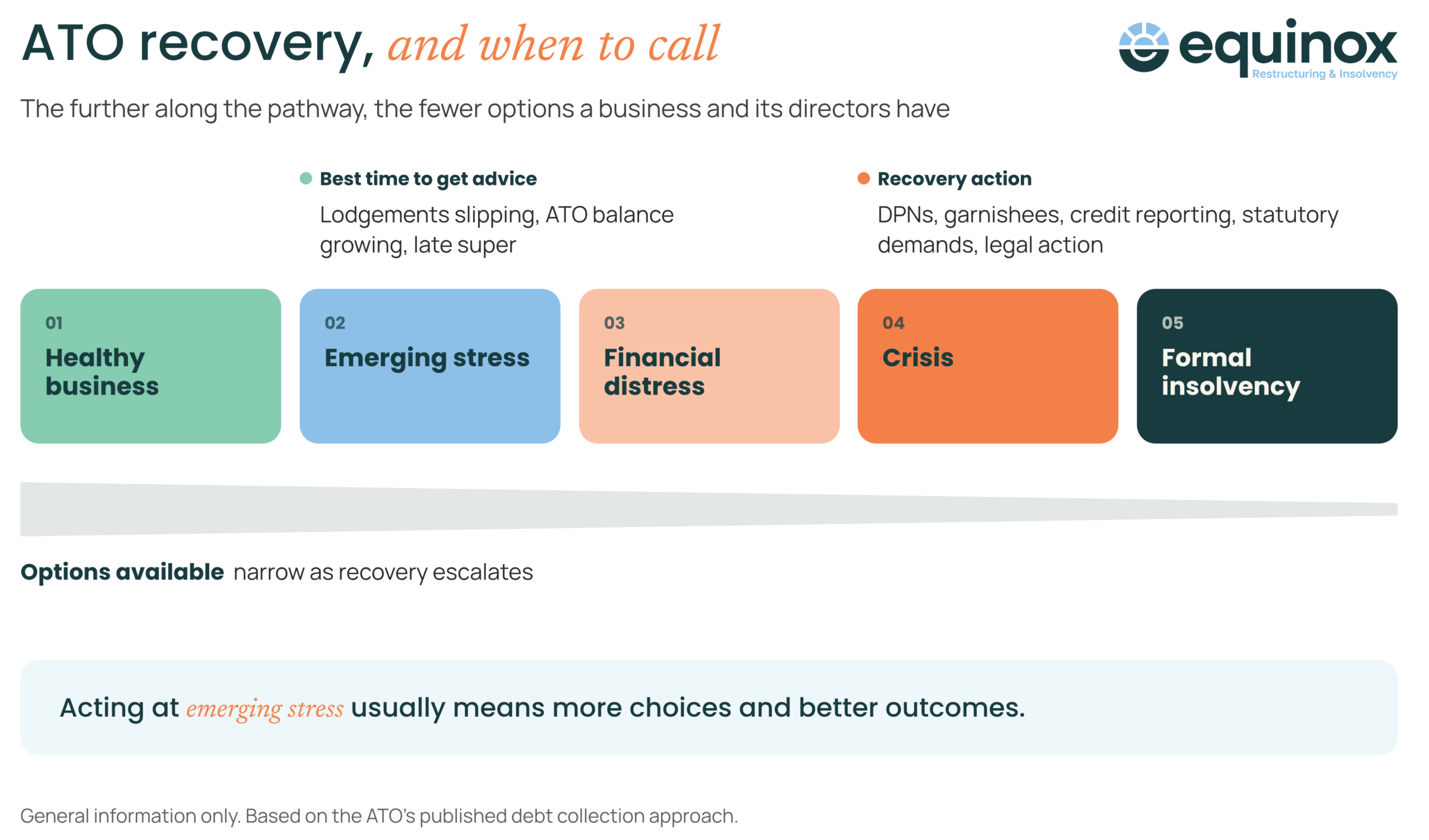
At the same time, the ATO describes a risk-based recovery model under which it seeks earlier engagement and assistance where a taxpayer has short-term financial difficulties, but moves to firmer action where taxpayers fail to engage or deliberately avoid their obligations. Available responses include payment arrangements and deferrals at one end of the spectrum, and Director Penalty Notices, garnishees, departure prohibition orders and legal recovery proceedings at the other.
In practice, recovery tends to progress from early intervention through to DPNs, garnishee notices, credit reporting and legal action. The warning signs advisers often see first include: growing PAYG, GST or SGC liabilities, overdue BAS or super obligations, repeated payment plan defaults, deteriorating cash flow and avoidance of communication with the ATO or advisers.
DPN activity remains exceptionally high
Perhaps the clearest evidence of the ATO’s recovery posture is the continued use of Director Penalty Notices (DPNs).
During 2025-26, the ATO issued 89,842 DPNs to individual directors, approximately 6% more than the 84,529 issued in 2024-25. Those notices related to company liabilities totalling approximately $5.1 billion. By 30 June 2026, the ATO had collected $1.5 billion against liabilities covered by notices issued during the year, compared with $1.2 billion collected at the equivalent point in the previous year.
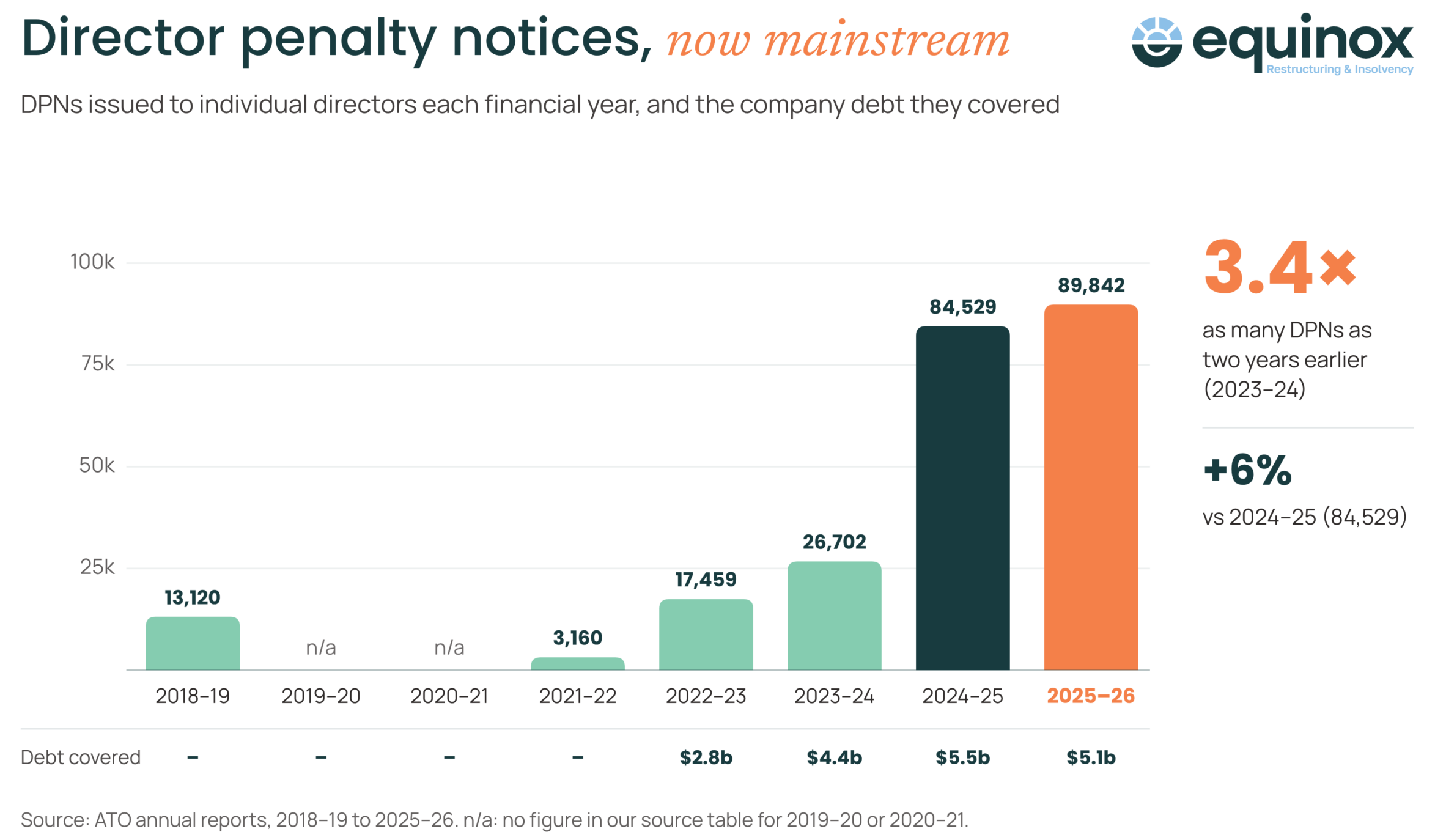
Those numbers make DPNs a mainstream debt recovery mechanism rather than an exceptional enforcement step.
For directors and advisers, the distinction between lockdown and non-lockdown DPN liabilities remains critical. Where relevant lodgments have been made within the statutory time requirements, the director may retain options following a DPN, including payment or putting the company into an appropriate restructuring or insolvency process within the applicable 21-day period. Where the underlying liabilities have not been reported within the required periods, the ability to remit the penalty by appointing an administrator, small business restructuring practitioner or liquidator can be lost.
The practical lesson is straightforward: lodgement is not the same thing as payment, and keeping lodgments current can preserve options even where a company cannot immediately pay its tax debt.
This is particularly important for SGC, where late or missing SGC statements can create serious personal exposure for directors. Late super can grow materially through nominal interest, administration charges and GIC, while also creating lockdown DPN exposure.
Super is an increasingly important part of the compliance picture
The annual report also shows the extent to which the ATO is attempting to identify unpaid super earlier.
During 2025-26, the ATO sent approximately 243,000 super guarantee reminders and nudges to employers. Those interventions resulted in approximately $467 million of super guarantee charge being raised, with a further $26 million of fringe benefits tax liabilities raised following employer contact.
Across its broader superannuation compliance activities, the ATO reports that it raised $2.2 billion of super guarantee charge liabilities, covering approximately one million employees, and distributed more than $1.1 billion to employee superannuation funds and individuals.
The “nudge” approach is worth watching. A nudge letter may appear considerably less serious than a formal recovery notice, but advisers should resist treating it as routine correspondence. It demonstrates that the ATO’s data has identified a potential compliance issue and provides an opportunity to address that issue before the matter moves further along the compliance and recovery pathway.
That becomes even more significant in the context of the move towards Payday Super and increasingly timely data available to the ATO. The direction of travel is towards earlier visibility of unpaid employee entitlements and consequently less time between non-compliance occurring, the ATO identifying it and recovery action commencing.
Other recovery tools are also being used
DPNs are only part of the story.
The annual report records 82 departure prohibition orders in 2025-26, compared with only 14 in 2024-25, an increase of almost 486%. Tax Integrity Program recoveries also increased from $540.4 million to $756.3 million.
The broader recovery toolkit available to the ATO includes garnishee notices directed to parties holding or owing money to a taxpayer, disclosure of qualifying business tax debts to credit reporting bureaus, statutory demands and winding-up proceedings. It’s a useful reminder that there can be a considerable difference between having an ATO debt that is being actively managed and having one that is simply being allowed to accumulate.
The Tax Ombudsman is now looking closely at debt collection
The ATO’s escalating use of debt recovery powers is also attracting external scrutiny.
The Tax Ombudsman’s review of the ATO’s administration of Director Penalty Notices puts an important part of the recovery system under the microscope. The review is particularly relevant given both the sheer volume of DPNs now being issued and the consequences a notice can have for an individual director.
Against that background, the Ombudsman’s recent reporting that tax complaints have surged amid concerns about ATO debt, interest and penalties is significant. The issues are interconnected. As historical debts accumulate GIC and the ATO increases recovery activity, disputes about payment arrangements, remission, recovery action and the administration of director penalties can be expected to assume greater importance.
The appropriate conclusion is not that the ATO should cease recovery action. An effective tax system clearly requires the Commissioner to collect established liabilities. Rather, the current reviews raise important questions about administrative fairness, communication, proportionality and whether taxpayers and directors are receiving adequate opportunity to understand and respond to the consequences of escalating recovery action.
For practitioners, the review is worth following. Its findings may ultimately affect how the ATO communicates with directors, administers DPNs and deals with taxpayers experiencing financial distress.
What should advisers be doing?
The annual report reinforces a message that restructuring practitioners have been giving directors for some time: early intervention matters.
The warning signs above provide a useful checklist. Advisers should be asking clients with emerging financial pressure:
- Are all BAS, IAS and SGC statements lodged and up to date?
- Is the ATO debt increasing from month to month?
- Is current super being paid when due?
- Has the business defaulted on an ATO payment arrangement?
- Could the directors already have personal exposure?
- Does the business have a realistic short-term cash flow forecast showing how both current liabilities and arrears will be dealt with?
Where the answer to several of these questions is unfavourable, waiting for a DPN, garnishee or statutory demand before seeking restructuring advice can materially reduce the available options.
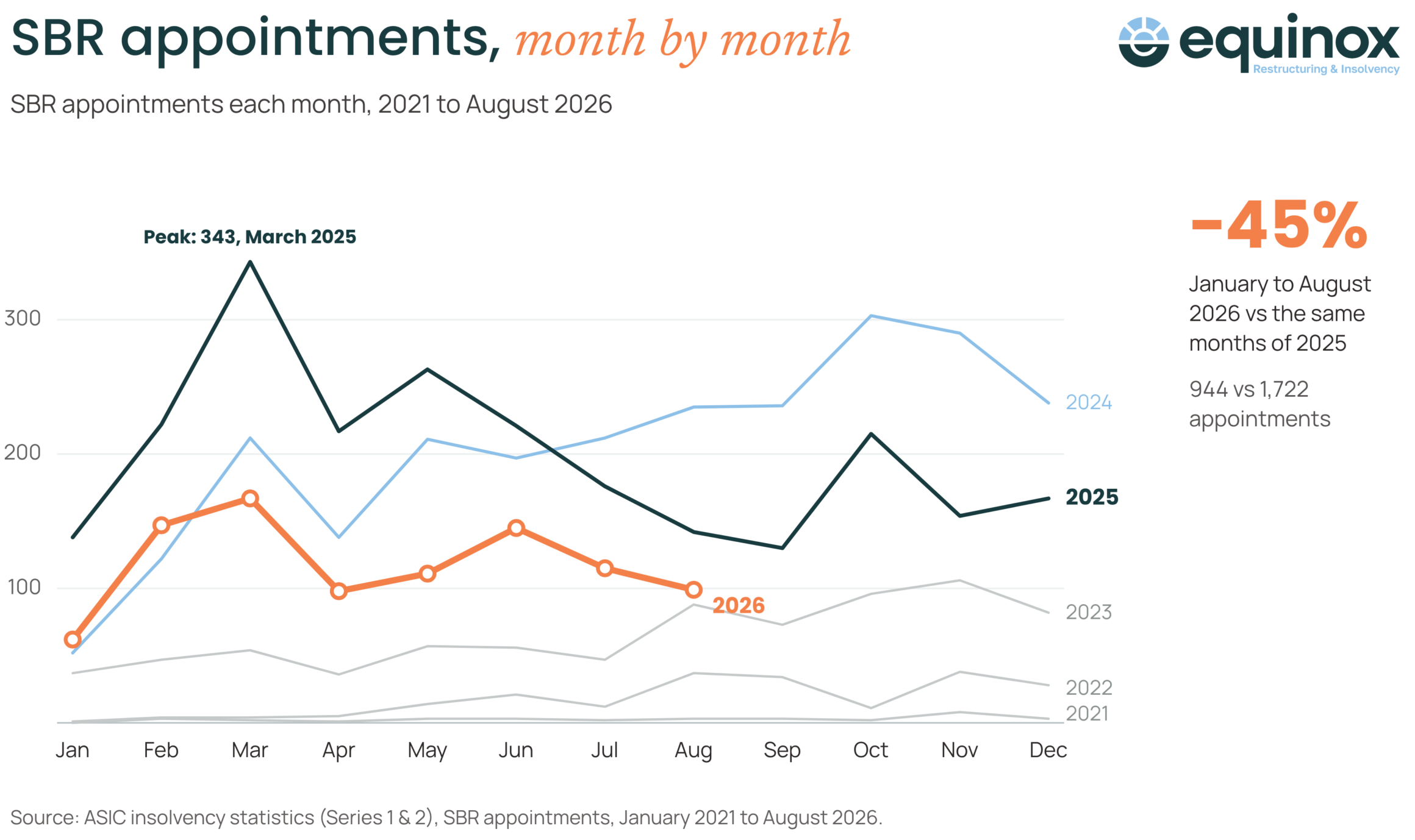
The same point applies to Small Business Restructuring. Data maintained by ASIC shows that SBR activity accelerated markedly through 2024 and 2025 before moderating in 2026. Whatever explains that recent moderation, restructuring is most useful while there remains a viable underlying business and before enforcement or lockdown liabilities severely constrain the directors’ choices.
The takeaway
The 2025-26 annual report paints a nuanced picture.
Australians are generally meeting their current tax liabilities, and on-time payment performance has improved. Yet the accumulated stock of tax debt continues to increase, collectable debt has reached $62.17 billion, small business accounts for roughly two-thirds of it, and insolvency debt has increased to $20.67 billion.
At the same time, the Commissioner is clearly prepared to use stronger collection tools. Nearly 90,000 DPNs in one year, $5.1 billion of liabilities covered by those notices, 243,000 super guarantee reminders and nudges, and the sharp increase in departure prohibition orders all point in the same direction.
For accountants and advisers, the practical implication is not simply that “the ATO is getting tougher”. It is that the cost of allowing tax and super liabilities to become an informal source of business finance is becoming progressively greater.
Keeping lodgments current, responding to ATO correspondence, monitoring current super and identifying personal director exposure should therefore form part of the regular financial health check for any business carrying material tax arrears. Where the business cannot meet both its ongoing obligations and a credible repayment arrangement for historical debt, early restructuring advice can preserve options that may disappear once the ATO moves further down the recovery pathway.
This article provides general information only and does not constitute legal, financial or taxation advice. It should not be relied upon as a substitute for advice specific to your circumstances. References to the Corporations Act 2001 (Cth) should be independently verified before republication.