Being a Director is More Than a Title: Helping Clients Understand What They Have Signed Up For
One of the things that continues to surprise us when dealing with businesses in financial difficulty is how little some directors understand about what it actually means to be a director.
That is not necessarily a criticism of the individuals involved.
Many people start or acquire a business because they are good at their trade, profession or industry. They understand their customers, their product and their people. Somewhere along the way a company is incorporated, their name goes down as a director and the focus quickly moves back to running the business.
What is often missing is the conversation about what becoming a director actually means.
A directorship is not simply a title on an ASIC company search. It carries legal responsibilities and, in certain circumstances, significant personal risk.
That is why ASIC’s Small Business Director Essentials learning and support resources are a welcome development. They provide an opportunity for accountants and other trusted advisers to start this conversation with clients before there is a problem.
“I didn’t know” is something we hear too often
When we become involved with a distressed company, we regularly encounter directors who have misconceptions about their responsibilities.
Sometimes a director believes their accountant is effectively responsible for the company’s financial affairs. Others assume that because they are not involved in the bookkeeping, finance or day-to-day administration, they have little responsibility for what has occurred.
There can be an assumption that the company structure provides an absolute shield against personal liability.
We also see people who agreed to become a director because their spouse, relative or business partner asked them to, without appreciating the significance of the appointment.
And sometimes directors simply haven’t been paying attention to the warning signs.
Yet the directors may not have stopped to ask the basic question:
What does all of this mean for me personally as a director?
By the time we are asked to answer that question, some of the options that were available six or twelve months earlier may no longer exist.
What does ASIC expect a director to understand?
At its heart, being a director means accepting responsibility for the governance of the company.
Directors cannot simply put their name on the paperwork and then disengage.
Under the Corporations Act, directors have duties that include acting with care and diligence, acting in good faith in the company’s best interests and for a proper purpose, and not improperly using their position or information obtained through their position.
There are also important obligations concerning the company’s financial position.
A director should have a reasonable understanding of how the business is performing, ensure appropriate financial records are maintained and pay attention to signs that the company may be experiencing financial difficulty.
That doesn’t mean every director needs to be an accountant.
It does mean that saying “I left all of that to somebody else” may not be an adequate response when something goes wrong.
ASIC has produced resources specifically for small business directors
This is where ASIC’s Small Business Director Essentials learning and support resources can be particularly useful.
For many small business owners, reading legislation or lengthy regulatory guidance is unlikely to be high on their priority list. ASIC’s Director Essentials material gives advisers a much easier starting point.
Rather than waiting until a director receives a demand, a Director Penalty Notice or insolvency advice, accountants can incorporate director education into their ordinary client conversations.
That might be as simple as saying:
“You’re a director of the company, so there are responsibilities that sit with you personally. ASIC has put together some useful resources explaining those responsibilities. I’d encourage you to work through them.”
That is a relatively small intervention, but it may trigger some very important conversations.
Accountants are ideally placed to spot the gap
For most SME directors, their accountant is one of their most trusted business advisers.
Accountants also see information that provides an early indication when things are beginning to deteriorate.
You may notice:
- BAS and IAS lodgments falling behind;
- an ATO integrated client account steadily increasing;
- superannuation not being paid on time;
- repeated ATO payment arrangements;
- payment arrangements being defaulted on;
- worsening debtor days;
- suppliers moving to COD or reducing credit limits;
- declining margins or continuing trading losses;
- directors injecting personal funds simply to make payroll; or
- poor or increasingly delayed financial information.
Individually, these issues may be manageable. Collectively, they can indicate that a company is moving towards financial distress.
That is the point at which understanding the director’s role becomes particularly important.
The accountant does not need to become the client’s lawyer or restructuring adviser. But there is considerable value in making sure the director understands that company financial distress can have consequences for directors personally, and that obtaining advice early generally provides more choices than waiting until enforcement action begins.
Personal liability can come as a shock
In our recent article, “Can I Just Resign? What Accountants Should Check When a Director Wants Out”, we looked at why leaving a directorship does not necessarily bring an end to a director’s exposure.
The conversation needs to start earlier. While a company is generally a separate legal entity, directors should understand where personal liability can arise while they are still in the role.
One important example is the ATO’s Director Penalty Notice regime, which can result in directors becoming personally liable for certain unpaid PAYG withholding, GST and superannuation guarantee charge liabilities.
As we discussed in our recent review of the ATO’s 2025-26 Annual Report, the Commissioner issued 89,842 Director Penalty Notices during 2025-26, covering approximately $5.1 billion of company liabilities. This is not a rarely used recovery power.
For directors of businesses with outstanding tax or superannuation liabilities, understanding these risks early can be critical.
There are also circumstances in which a director may face claims associated with breaches of their duties or insolvent trading.
The lesson is not that directors should become frightened of being directors. Australia needs people prepared to start, operate and grow businesses.
The lesson is simply that they should understand the job they have accepted.
A useful annual conversation with every company client
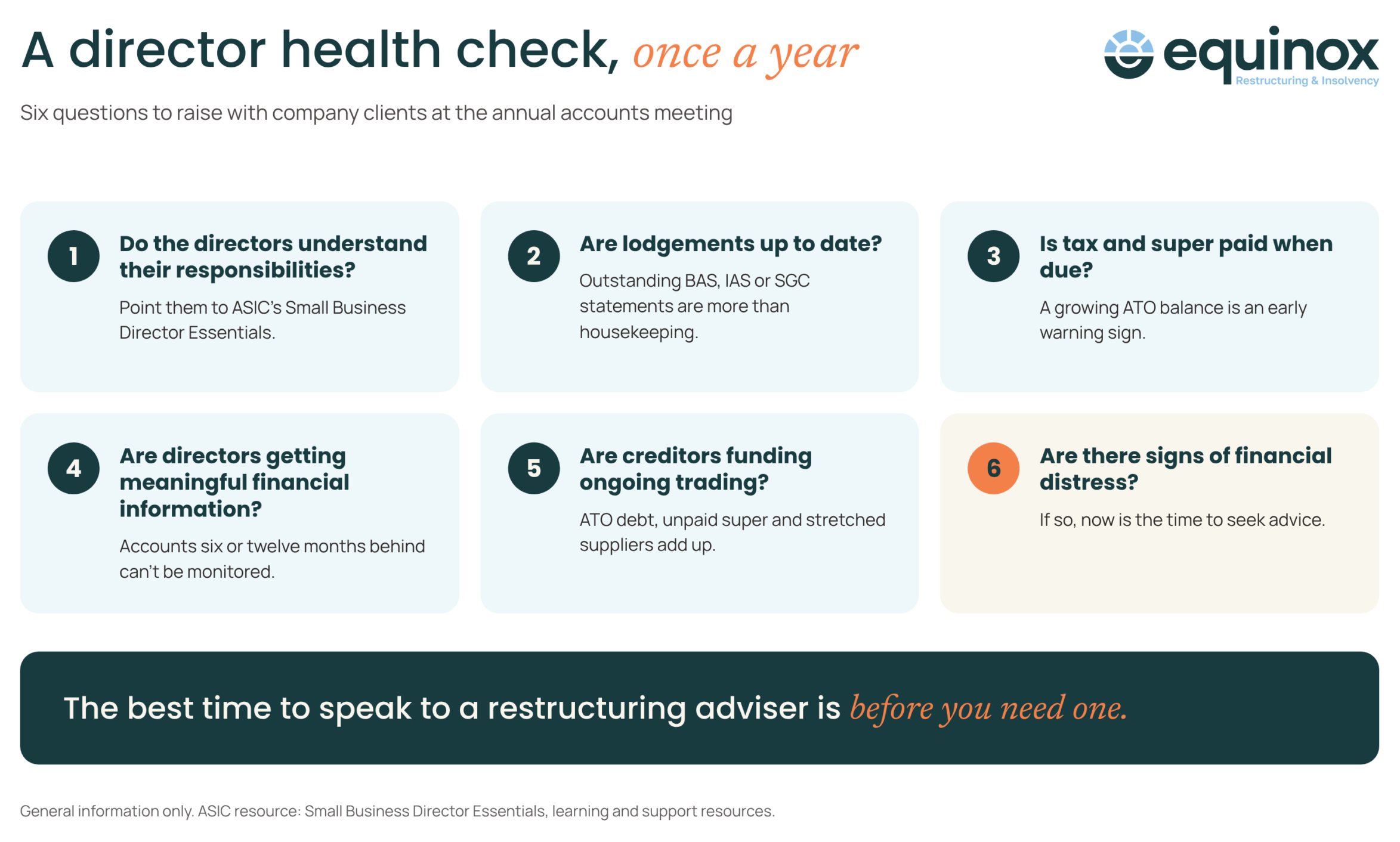
We think there is an opportunity here for accountants to build a simple “director health check” into their annual client process.
It doesn’t need to be complicated.
For example, when completing annual accounts or meeting with the directors, consider asking:
- Do all of the directors understand their responsibilities? Don’t assume they do simply because they have been directors for many years. Point them towards ASIC’s Small Business Director Essentials learning and support resources and encourage them to complete the relevant material.
- Are the company’s lodgments up to date? Outstanding BAS, IAS or SGC statements should be treated as more than an administrative housekeeping issue.
- Is tax and super being paid when due? Look beyond whether returns have been lodged. A growing ATO balance can be an important early warning sign.
- Are the directors receiving meaningful financial information? Ask whether they actually understand the company’s cash flow, profitability, balance sheet and liabilities. A director cannot meaningfully monitor a company’s financial position if the accounts are perpetually six or twelve months behind.
- Is the company relying on creditors to fund ongoing trading? Growing ATO debt, unpaid super, stretching suppliers and repeated payment plans can indicate that creditors are effectively financing the business.
- Are there signs the company may be approaching financial distress? If there are, that is the time to seek advice.
Education is an important form of early intervention
When we meet directors after a business has entered serious financial difficulty, there is often a moment when the director says something along the lines of:
“I wish someone had explained this to me earlier.”
That is what makes ASIC’s initiative useful.
Resources alone will not solve every problem. Directors still have to read them, understand them and act on them.
But accountants can play an important role in making that happen.
You don’t need to lecture clients on the Corporations Act. You don’t need to turn an annual accounts meeting into a corporate governance seminar.
Sometimes the most valuable thing you can do is simply make a client aware that being a director carries responsibilities beyond running the operations of the business, point them towards credible information, and encourage them to ask questions about anything they don’t understand.
And if their financial position is starting to deteriorate, encourage them to obtain appropriate advice early.
Because “I didn’t realise I was responsible for that” is a much better conversation to have while a business is healthy than after something has gone wrong.
A resource worth sending to your director clients
ASIC has developed its Small Business Director Essentials material to help directors better understand their role and responsibilities.
If you advise directors of SMEs, consider adding the resource to your annual client checklist or including it in your next client communication: ASIC: Small Business Director Essentials, Learning and Support Resources
This article provides general information only and does not constitute legal, financial or taxation advice. It should not be relied upon as a substitute for advice specific to your circumstances. References to the Corporations Act 2001 (Cth) should be independently verified before republication.