Bankruptcy Reforms: A Fairer Chance to Start Again?
The Federal Government has recently announced proposed reforms to Australia’s personal insolvency system, aimed at reducing some of the longer-term consequences of bankruptcy and providing individuals with a better opportunity to rebuild following financial failure.
The reforms seek to modernise the bankruptcy framework and strike a better balance between allowing an individual a genuine fresh start and protecting the legitimate interests of creditors. The Government has outlined the changes in its announcement, Bankruptcy reforms give Australians a fairer chance to start again.
For accountants, lawyers and advisers, the proposals are particularly relevant when dealing with directors and small business owners whose business difficulties have resulted in significant personal debt.
What is proposed?
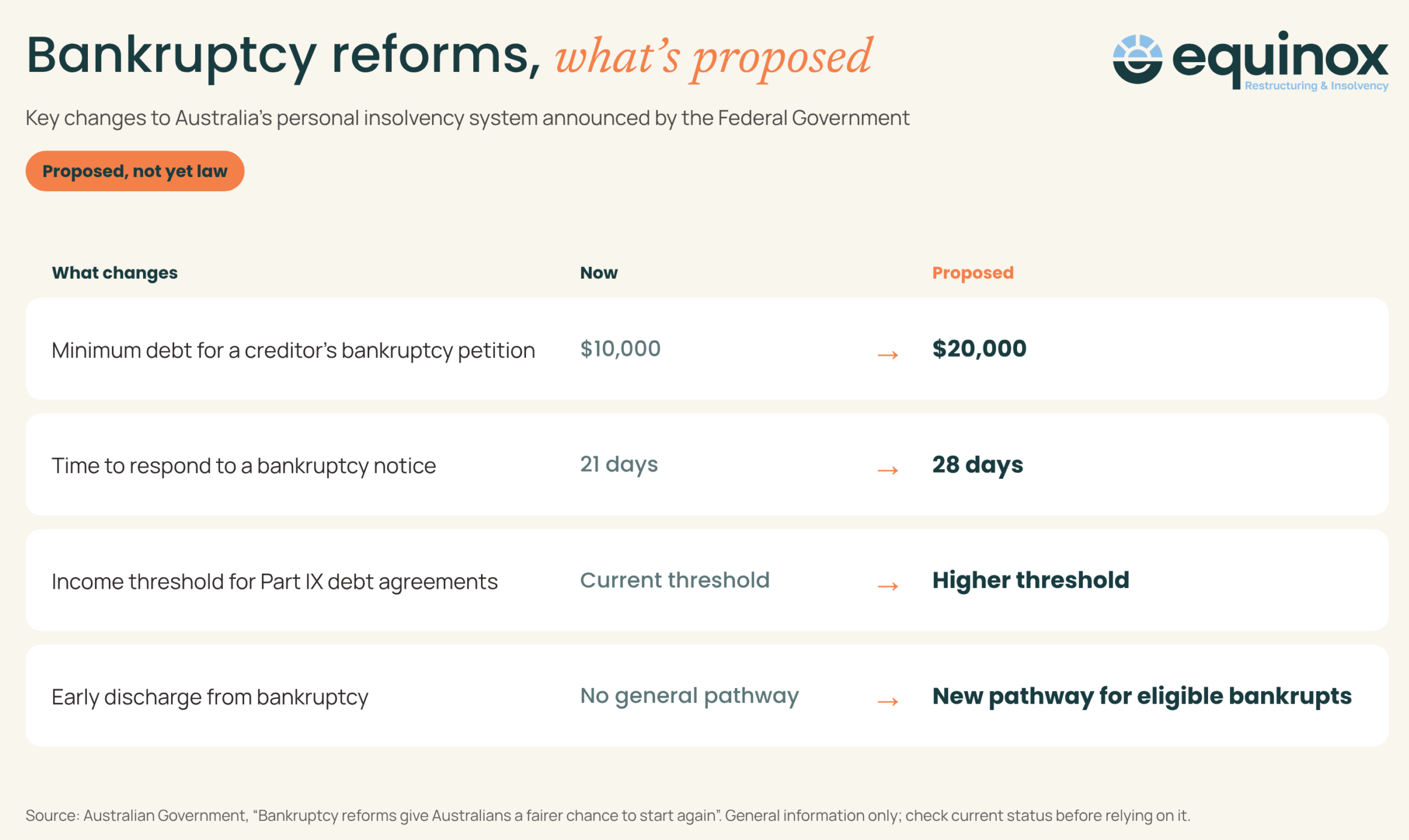
The Government has outlined a number of changes to the personal insolvency framework, including:
- Increasing the minimum bankruptcy threshold from $10,000 to $20,000. This is the minimum debt generally required before a creditor can seek to have an individual made bankrupt.
- Increasing the time to respond to a bankruptcy notice from 21 days to 28 days. This would provide debtors with additional time to respond before failure to comply with the notice can constitute an act of bankruptcy.
- Increasing the income threshold for debt agreements, potentially making Part IX debt agreements available to a broader group of financially distressed individuals as an alternative to bankruptcy.
- Introducing a new pathway for early discharge from bankruptcy, providing scope for eligible bankrupts to exit bankruptcy earlier than the ordinary bankruptcy period.
- More broadly, the reforms seek to reduce unnecessary barriers to rebuilding after financial failure, while retaining appropriate protections for creditors.
Importantly, these are proposed reforms, rather than changes that advisers should assume are already operative.
What could the reforms mean in practice?
The proposed increase in the creditor’s petition threshold from $10,000 to $20,000 is significant.
Bankruptcy is a serious recovery mechanism and the higher threshold would make it less readily available for comparatively modest debts. It would not make those debts disappear or prevent creditors pursuing other enforcement options, but it would raise the threshold for using bankruptcy proceedings as the ultimate recovery tool.
Similarly, increasing the time to comply with a bankruptcy notice from 21 days to 28 days provides some additional breathing room. An extra seven days may not seem substantial, but for someone experiencing acute financial distress it can provide valuable additional time to obtain advice, negotiate with a creditor or assess their personal insolvency options.
The proposed expansion of access to Part IX debt agreements is also worth watching. Debt agreements can provide eligible individuals with an alternative to bankruptcy by allowing a proposal to be put to creditors to deal with their debts. A higher income threshold may make this pathway available to a broader group of debtors.
Perhaps the most interesting proposal is the new early discharge pathway. If implemented, this may represent an important move towards a more rehabilitative personal insolvency system, recognising that keeping someone bankrupt for longer than necessary does not necessarily produce a better outcome for the individual, creditors or the broader economy.
Particularly relevant for directors and small business owners
Although bankruptcy is a personal insolvency process, these reforms have obvious relevance to small business.
The financial consequences of a failed business do not always remain within the company.
By the time we become involved, we often see directors who have personally guaranteed company borrowings or leases, advanced their own funds to support the business, accumulated personal debt to fund ongoing trading or become exposed to personal liability for certain unpaid company tax obligations.
The company may therefore be only one half of the problem.
Once its affairs are addressed, the director can be left with substantial personal liabilities and insufficient assets or income to deal with them.
That is why personal financial circumstances should form part of the conversation when advising directors of distressed companies. Fixing or closing the company does not necessarily resolve the financial position of the people behind it.
Bankruptcy remains a significant decision
A policy objective of giving people a genuine fresh start should not be confused with bankruptcy becoming an easy or consequence-free option.
Bankruptcy can have important consequences for a person’s assets, income, access to credit, business activities and ability to hold certain positions. Transactions entered into before bankruptcy may also be examined by a bankruptcy trustee.
For that reason, individuals experiencing financial difficulty should obtain advice about all available options before deciding on bankruptcy.
This becomes particularly important where the individual’s affairs involve matters such as:
- an interest in the family home or other real property;
- jointly owned assets;
- director guarantees;
- ATO liabilities and Director Penalty Notices;
- loans or transactions involving relatives and related entities;
- significant superannuation interests;
- recent asset transfers; or
- an ongoing business or company that also needs to be restructured.
The earlier these issues are identified, the greater the opportunity to properly assess the available options.
A welcome focus on the fresh start
There is a necessary tension in any insolvency system.
Creditors need effective mechanisms to enforce legitimate debts, and individuals should remain accountable for their financial obligations. At the same time, a system that unnecessarily prevents someone from recovering from financial failure can be counterproductive.
This is particularly relevant for genuine business failure. Entrepreneurship inevitably involves risk, and not every unsuccessful business is the result of misconduct or irresponsible behaviour.
The proposed reforms recognise that financial failure should have consequences, but those consequences should not unnecessarily prevent an individual from making a genuine fresh start.
For accountants and advisers, the immediate message is to watch the reforms as they progress and continue encouraging clients experiencing significant personal financial pressure to seek advice early.
Waiting until a bankruptcy notice arrives rarely creates more options.
Further information: Bankruptcy reforms give Australians a fairer chance to start again.
This article provides general information only and does not constitute legal, financial or taxation advice. It should not be relied upon as a substitute for advice specific to your circumstances. References to the Corporations Act 2001 (Cth) should be independently verified before republication.